
Carlos Martiel: Dark Age
Curated by Anjuli Nanda Diamond and George Bolster
September 17, 2026 – January 30, 2027
Opening Reception
September 17, 6-8pm
Performances:
Dark Age, September 19, 2pm
Mano de hierro, October 8, 7pm
Fear of Them, December 10, 7pm
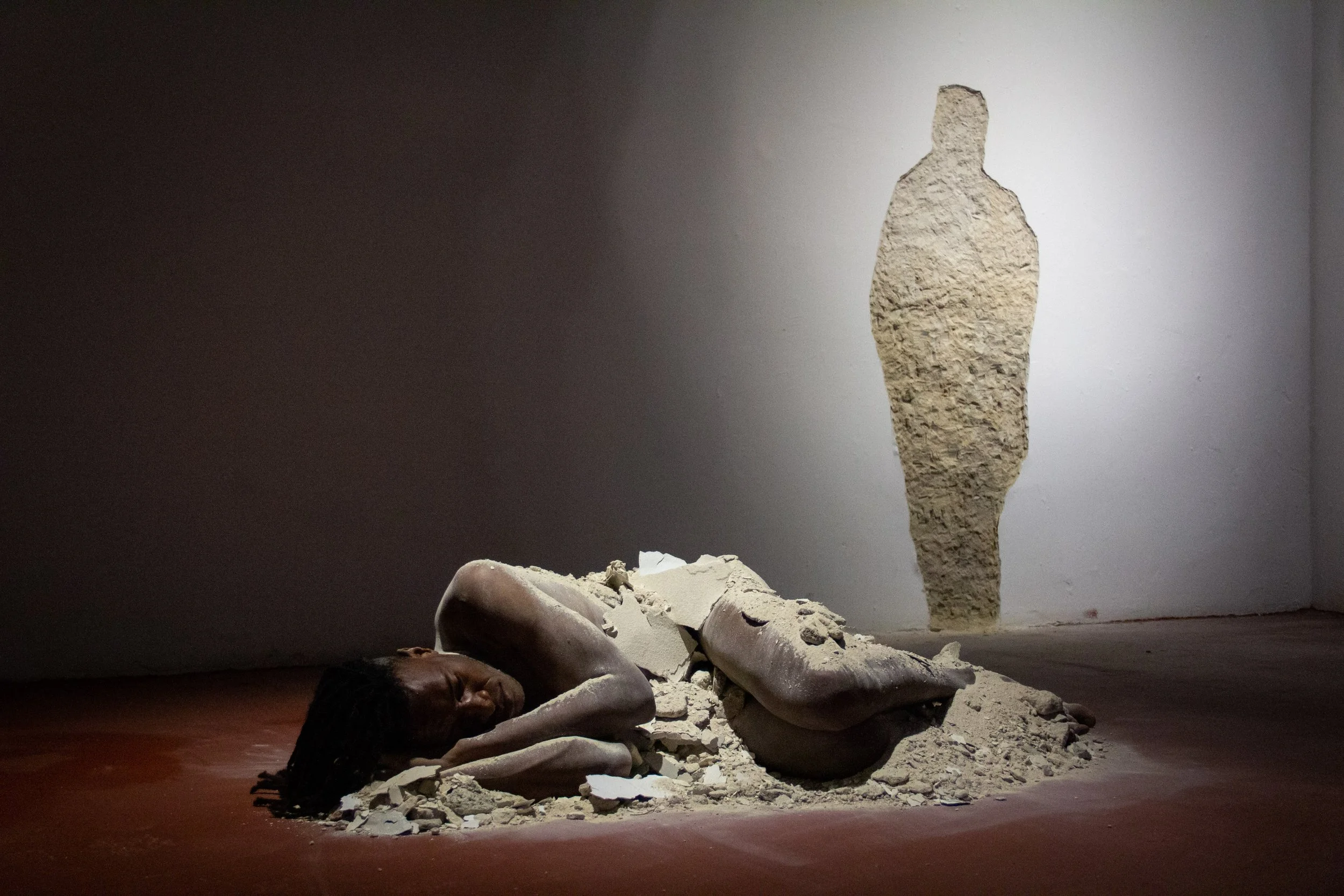
Carlos Martiel, Ascendencia Charrúa (Charrúa Ancestry), 2018. Espacio de Arte Contemporáneo, Montevideo, Uruguay. Photo by Elena Téliz.
The Shelley & Donald Rubin Foundation is delighted to present Dark Age, a solo exhibition by Cuban performance artist Carlos Martiel, opening on September 17, 2026 at The 8th Floor and on view through January 30, 2027. The artist will score three new performances for this experimental exhibition: Dark Age (September 19), Mano de hierro (Iron Hand) (October 8), and Fear of Them (Miedo a ellos) (December 10). In addition to these presentations, the exhibition will stage documentation and ephemera related to key works, as well as a new series of drawings.
Dark Age grapples with the temporality of performance and the possibility of making this art form structural, enabling a longevity for how the viewers experience these fleeting moments. The subsequent documentation and staging of Dark Age, Mano de hierro (Iron Hand), and Fear of Them will become artworks in their own right, resulting in an archival presence as they are produced. Building on seminal works from recent years, that show the development and shift from solely using his body in pieces such as Lazos de Sangre (Bloodline), 2010, to the participation of family members in Vaciamiento (Emptiness), 2024, his brother will take part in the new piece Dark Age, 2026. The artist will also foreground a lesser-known element of his practice: a new suite of drawings titled Metafísica del poder (Metaphysics of power), a body of work distinct from his performance drawings.
For almost twenty years Carlos Martiel has dedicated himself to performance art, exhibiting works all over the world. Martiel’s practice often takes his own pain threshold and bodily duration to its highest possible exponent, confronting and destabilizing the viewer. As the artist states in an interview with Coco Fusco commissioned for the exhibition: “My body is an archive of my performances; the scars I have drawn on it reveal the battlefield that my soul has had to traverse in its journey through this world. These scars reveal continuous and systematic stories of oppression that need to be re-examined and are ‘symbolically’ visible to all who wish to observe them candidly, in broad daylight.” This embodiment of pain encompasses the experiences of the Black male body, queerness, anti-Blackness, Cuban/Jamaican identity, migration, and the moral predicaments of being human in the 21st century. Throughout his practice, Martiel proposes a simple but eternal question about humanity: does everything come down to violence?
The artist’s body is a proxy for every abuse inflicted on other humans. Martiel’s performances distill concepts of colonialism, systemic violence, and genocide, forcing viewers to bear witness and confront their complicity. His durational stoicism obligates his audience to address their own engagement with politics, community, morality, and activism.
Paradoxically, the inwardly turned violence in Carlos Martiel’s work signals his belief that humans can evolve past violence; there is an optimism implying that we as people can change. He believes this is an important time to embrace the role of an artist as activist. Martiel states: “To raise one’s voice in the name of somebody who is unable to raise their own is a responsibility. I have traveled enough to learn that the whole world is my home, and that there is always something binding me to all those who share it with me, regardless of the degree of awareness we have of that fact.” As he also notes when discussing Metafísica del poder (Metaphysics of power), “a revolution of love is coming.”
Carlos Martiel (born in 1989 in Havana) lives and works in New York. He graduated in 2009 from the National Academy of Fine Arts, “San Alejandro,” in Havana. Between 2008 and 2010, he studied in the Cátedra Arte de Conducta, directed by the artist Tania Bruguera. Martiel’s works have been included in the 11th Lanzarote Biennial, Spain; Biennial of the Americas, USA; 4th Vancouver Biennale, Canada; 14th Sharjah Biennial, UAE; 14th Cuenca Biennial, Ecuador; 57th Venice Biennale, Italy; Casablanca Biennale, Morocco; Biennial “La Otra”, Colombia; Liverpool Biennial, United Kingdom; Pontevedra Biennial, Spain; Havana Biennial, Cuba. He has had performances at The Leslie-Lohman Museum of Art, New York; USA, Solomon R Guggenheim Museum, New York; USA, El Museo del Barrio, New York; USA, Stedelijk Museum, Amsterdam, The Netherlands; La Tertulia Museum, Cali, Colombia; Centro de Arte Contemporáneo, Quito, Ecuador; Walker Art Center, Minneapolis, USA; The Museum of Fine Arts Houston (MFAH), Houston, USA; Museo de Arte Contemporáneo del Zulia (MACZUL), Maracaibo, Venezuela; Padiglione d’Arte Contemporanea, Milan, Italy; Nitsch Museum, Naples, Italy. He has received several awards, including the Franklin Furnace Fund in New York, USA, 2016; “CIFOS Grants & Commissions Program Award” in Miami, USA, 2014; “Arte Laguna” in Venice, Italy, 2013. His work has been exhibited at The São Paulo Museum of Art (MASP), São Paulo, Brazil; The Museum of Latin American Art (MOLAA), Long Beach, USA; Zisa Zona Arti Contemporanee (ZAC), Palermo, Italy; Patricia and Phillip Frost Art Museum, Miami, USA; Benaki Museum, Athens, Greece; National Museum of Fine Arts, Havana, Cuba; among others. His works are in public and private collections such as The Solomon R Guggenheim Museum, New York; The Pérez Art Museum Miami (PAMM), Miami; Museu de Arte do Rio, Rio de Janeiro.
Press release PDF
Brochure
Plain-text essay
Image description: A Black man is sleeping nude in a pile of dust, drywall, and rocks. Behind him is a white wall, with the outline of a human cracked away revealing the layer below.